

Water Management
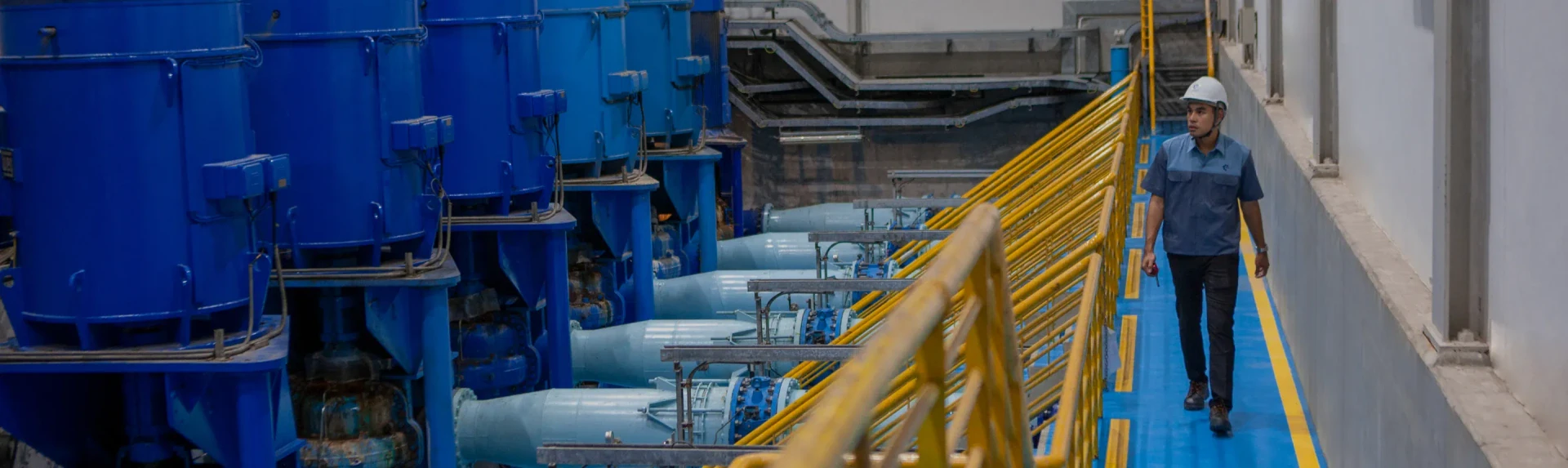

Water management service provided to Provincial Waterworks Authority
TTW engages in the production and distribution of tap water under a Build-Own-Operate (BOO) model through a 30-year agreement with the Provincial Waterworks Authority (PWA), covering Nakhon Pathom, Samut Sakhon, and Pathum Thani provinces. The company holds a concession from the Ministry of Natural Resources and Environment.
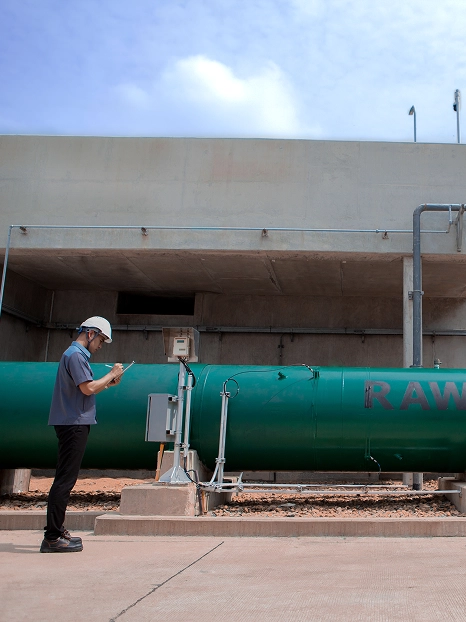
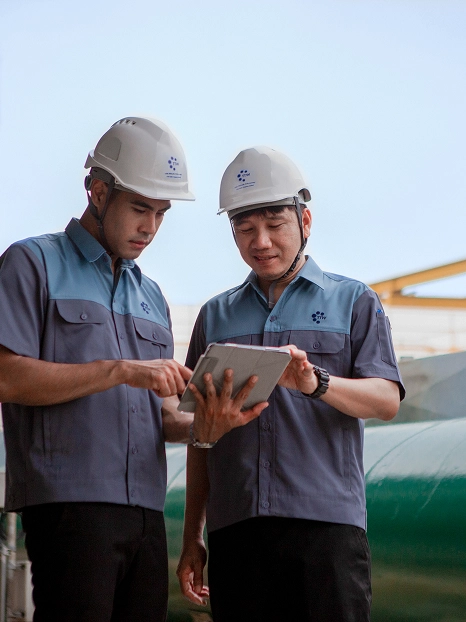
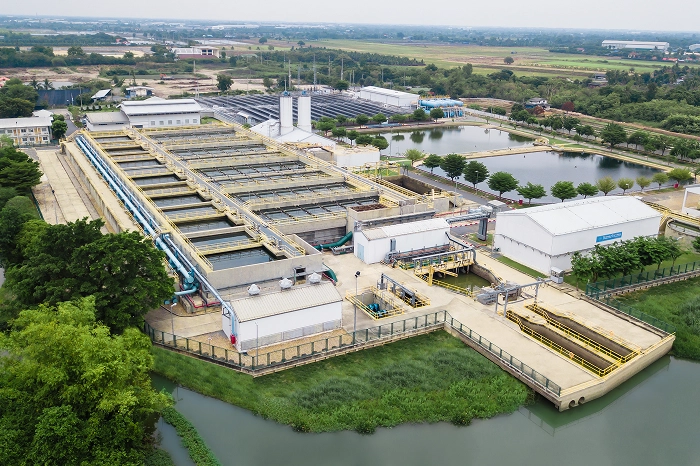
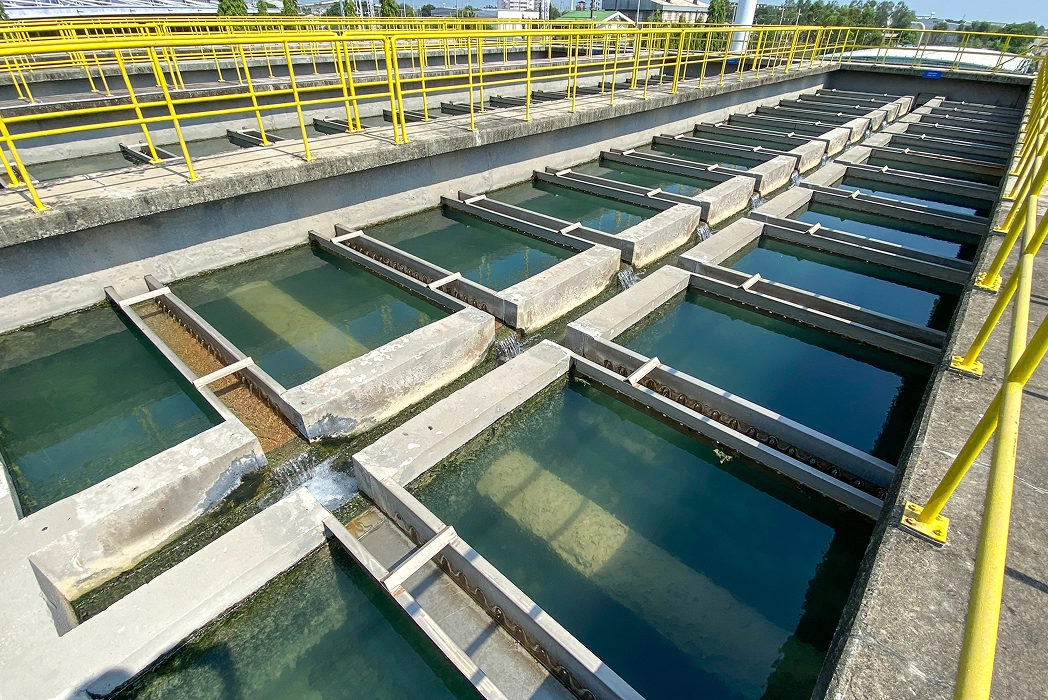
Produces and Distributes Tap Water
TTW produces tap water by pumping raw water from the Tha Chin River into the water production process. The Banglen Water Treatment Plant, located in Bang Rakam Subdistrict, Banglen District, Nakhon Pathom Province, on the east side of the Tha Chin River, has a maximum production capacity of 440,000 cubic meters per day. The second water treatment plant, the Krathumbaen Water Treatment Plant, is situated on Setthakit 1 Road, Khlong Maduea Subdistrict, Krathumbaen District, Samut Sakhon Province. It has an initial production capacity of 100,000 cubic meters per day, expandable up to 400,000 cubic meters per day, serving as a backup water treatment facility. This results in a total production capacity of 540,000 cubic meters per day.
The production process at the water treatment plants, the distribution of tap water to both water treatment plants and the tap water distribution process to the PWA is controlled by the Supervisory Control and Data Acquisition (SCADA) System which is able to control water production and distribution to distribution stations efficiently. Such a system was installed in a control building which was located separately from the tap water production plant.
Operates of Water Treatment and Maintenance to the Provincial Water Works Authority
TTW produces and supplies tap water that meets the quality standards specified in the water purchase agreement with PWA and complies with the Thai Industrial Standards (TIS) set by the Thai Industrial Standards Institute (TISI), Ministry of Industry. To ensure quality compliance, TTW conducts continuous quality control tests at every stage of production, from chemical dosing to sludge removal and water distribution from the treatment plants. Additionally, water samples are submitted to the Department of Health, Ministry of Public Health, for testing at least once a month. As a result, TTW's tap water has consistently met PWA's quality standards since production began on January 5, 2004, in accordance with TIS 257 Part 1-2521.
Business Characteristic
TTW Public Company Limited (TTW) operates the production and distribution of tap water in line with the government’s policy to ensure the public has access to an adequate, continuous, and high-quality supply of tap water.

Process Diagram

Water Production Procedures
Comprised of 3 procedures; clarification, filtration and disinfection. Key and supporting production processes are as follows:
Raw water from the river will flow through the floating boom, bar screen and then band screen, which are installed to separate weed, moss, residue and contaminants in the water from accessing the production system.

Raw water that has been pumped into the production system will normally contain suspended solids in it, and thus chemical needs to be added to remove such suspended solids. Initially, potassium permanganate (KMnO4) and lime may be added in the raw water pipeline to adjust the acidity and alkalinity (pH), which will facilitate the clarification process. After that, alum and polymer will be added to further facilitate clarification. These 3 chemicals will be added to the rapid mixing tank in order for them to react with the sediment and the turbidity of the water, leading to faster sedimentation.
Once the chemical-added raw water has been mixed in the tank, it will be transferred into the clarifier, by getting through the tri-dent and them down to the bottom of the tank and eventually lifted to the top. Clear water at the uppermost will overflow into the gutter through to the filter. Meanwhile, sediment, once gathered together, will form sludge, will be drained out to the sediment removal system. Water processed from the clarification system will then be transferred into the production process again, while sludge cake will be disposed of in the designated area.

The water from the clarification process will still have minor suspended solids contaminated in it, and these will have to be removed using the rapid sand filter, which will trap the contaminants or suspended solids at the surface and the filter. Water that passes through this sand filter shall have the turbidity level of not more than 1 NTU.

Before distributing water to consumers, appropriate amount of chlorine will be added (post-chlorine), which is adequate to kill germs in clear water tanks and distribution pipeline so that consumers can get clean, pure and standard-quality water.

Sediments drained from the clarifier will be transferred to the sludge thickening tank to separate water from sediment. The water acquired from this process will be transferred back to the production process, while the sediment will be transferred to the belt press, and then be disposed of in the designated area.
