

Stakeholder Engagement

The Company recognizes the importance of stakeholder engagement , and believes that trust-based relationships, along with stakeholders’ perspectives and feedback, are valuable assets that contribute to achieving its sustainable growth and long-term development objectives.
Effective stakeholder management enables the Company to respond to stakeholder needs efficiently, mitigate risks that may adversely impact corporate reputation and business continuity, and deliver shared value to all stakeholder groups. The Company maintains regular and ongoing stakeholder engagement to foster mutual understanding of key issues and to systematically integrate stakeholder feedback into its decision-making processes and business planning.
Business Stakeholder Relationships Across the Value Chain
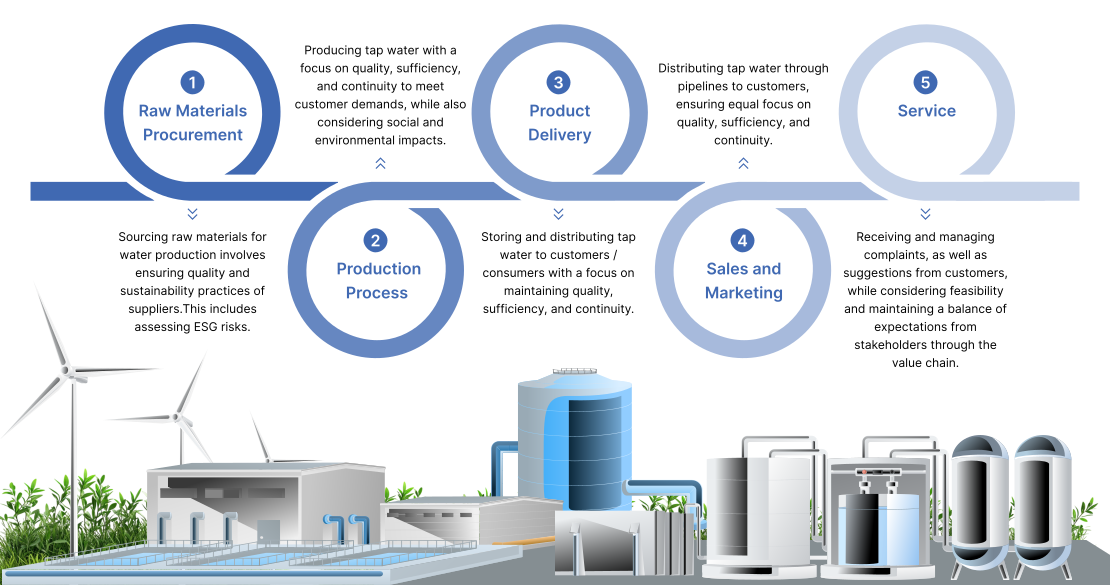
The Company has analyzed the relationships between its business operations and stakeholders across each activity, enabling the identification and management of material sustainability issues that are critical to value creation in its products and services, as well as to strengthening its competitive advantage. The Company’s value chain comprises five interrelated core activities spanning upstream to downstream operations, as follows:
Stakeholder Engagement Process
- Stakeholder Identification is Based on Three Criteria
- stakeholders with direct relevance to the Company’s business operations.
- stakeholders impacted by the Company’s sustainability-related activities.
- stakeholders with the ability to influence the Company’s sustainability performance.
- Assign Responsible Departments for Stakeholders.
- Define Methods to Survey Stakeholders’ Needs and Expectations.
- Collect Stakeholders’ Needs and Expectations.
Assess and prioritize stakeholder needs and expectations in the context of impacts, risks, and opportunities, as well as alignment with the Company’s policies and strategic objectives. The evaluation considers both the significance to stakeholders and the relevance to the Company.
The outcomes of the analysis are presented to the Company’s Sustainability Committee to guide the direction of sustainability initiatives and inform the development of the Company’s strategies.

Employees are a key driver of the Company’s success. The Company is committed to establishing fair human capital management and performance evaluation systems, promoting equal opportunities and career advancement, and continuously developing employees’ knowledge and capabilities. It also ensures a safe working environment in line with international best practices, while fostering a positive organizational culture and inclusive workplace atmosphere.
The Company extends its care beyond employees to their families through various engagement initiatives. These include regular “Managing Director Meets Employees” sessions to encourage open dialogue and feedback, the promotion of continuous improvement and innovation through Kaizen initiatives, the provision of educational scholarships for employees’ children, and annual employee engagement and satisfaction surveys. In addition, monthly birthday activities are organized to enhance employee morale, well-being, and overall engagement.

The Company is committed to accountability and maximizing shareholder satisfaction by pursuing sustainable growth and delivering consistent, appropriate returns. It operates with transparency, supported by robust accounting systems, internal controls, and audit processes. The Company ensures timely and equitable disclosure of information to both retail and institutional investors through multiple channels, enabling convenient and prompt access to relevant information. Key engagement channels include the Annual General Meeting (AGM), plant visits, analyst meetings, and interactions with credit rating agencies.
The Company respects and upholds shareholders’ rights, encouraging the full exercise of legal entitlements, including the right to attend shareholder meetings, express opinions, and vote. In addition, minority shareholders are provided the opportunity to propose agenda items in advance and to nominate qualified candidates for election to the Board of Directors.

The Company is committed to enhancing customer satisfaction and trust by delivering high-quality, safe, and fairly priced products and services. It continuously elevates operational and service standards while fostering long-term customer relationships.
To support these objectives, the Company conducts regular engagement initiatives, including periodic performance review meetings, training programs, information services, technical support, and initiatives to promote efficient water usage. It also implements structured complaint management processes and annual customer satisfaction surveys. In addition, the Company organizes customer relationship activities such as off-site meetings, community support events, and educational scholarships for customers’ families to strengthen engagement, loyalty, and long term value creation.

The Company upholds fairness, integrity, and mutual benefit in its business relationships, guided by a strong code of business conduct. It strictly complies with applicable laws, regulations, and contractual obligations, while fostering strategic partnerships and maintaining constructive relationships with all counterparties.
The Company promotes collaborative engagement through joint problem-solving meetings, capacity-building and training programs, and site visits to suppliers’ production and service facilities. These initiatives support continuous improvement across the value chain, contributing to sustainable industry development and delivering broader social and economic value.

The Company places great emphasis on supporting both local and non-local communities, prioritizing safety, well-being, and quality of life. It operates its business alongside initiatives to prevent or mitigate potential impacts on communities and the environment, while contributing positively to social development to enable sustainable, shared growth.
Most of the Company’s social initiatives focus on education, vocational development, and community problem-solving, recognizing that education and social well-being are critical to national development and have long-term implications for the Company’s business. The Company implements programs that simultaneously generate business, social, and environmental benefits. For example, the “Water Sludge Product Development Project” transforms waste into value-added products by employing community members to produce terracotta tiles, which are then used in constructing school buildings in Samut Sakhon and Nakhon Pathom provinces.

The Company prioritizes environmental responsibility throughout its production processes to minimize external environmental impacts. Initiatives include recycling wastewater from production back into tap water, converting sludge into construction materials for community use, and implementing water quality restoration projects such as the Bang Sue Canal rehabilitation in collaboration with government agencies and local communities.
The Company actively participates in discussions on water resource management with sub-basin committees, engages in watershed reforestation, provides training on water conservation for employees and communities, and continuously collaborates with local communities to address environmental challenges.
Recognizing the importance of climate change mitigation and energy conservation, the Company has implemented Solar Rooftop and Floating Solar Cell projects to reduce electricity consumption. Additionally, it establishes energy-saving measures and sets targets to lower greenhouse gas emissions, demonstrating its commitment to responsible environmental stewardship in all business operations.
The Company reports on its performance in addressing stakeholder needs and expectations in the Annual Report and Form 56-1 One Report, which are publicly available on its website: https://www.ttwplc.com/en/document/viewer/187634/form-56-1-one-report-2025
As a water production and distribution company, the identification of Vulnerable Stakeholders is part of the Company's stakeholder engagement and human rights due diligence process. The Company adopts the following process:
- Identify potentially affected areas and activities.
- Conduct stakeholder mapping.
- Establish criteria for identifying vulnerable stakeholders.
- Collect relevant information.
- Assess the level of vulnerability and potential impacts.
- Develop targeted measures for vulnerable groups.
- Review and continuously improve the process.
Examples of Vulnerable Stakeholder Groups
| Stakeholder Group | Reason for Being Considered Vulnerable |
|---|---|
| Older persons | May have limited access to information and services. |
| Persons with disabilities | May require accessible communication channels and services. |
| Low-income households | May face financial constraints and limited access to services. |
| Schools | Depend on a reliable supply of clean water for students' well-being. |
| Hospitals and healthcare facilities | Require a continuous water supply to provide essential healthcare services. |
| Childcare centers | Require clean water to ensure children's health and hygiene. |
| Communities near construction sites | May be affected by noise, dust, traffic, or temporary water supply interruptions. |
In addition, the Company uses information from community surveys, meetings with community leaders, grievance records, and local authority data to identify vulnerable stakeholders. The assessment results are used to develop communication plans, targeted mitigation and support measures, and are regularly reviewed and updated. Their effectiveness is monitored through grievance trends, stakeholder satisfaction levels, and stakeholder engagement performance.
