

Sustainable Policies and Strategies

The Company recognizes and places great importance on conducting its business sustainably, in accordance with the organization’s vision: “To be a leading company in the country in the water, energy, and environmental sectors.”
By conducting its business with good corporate governance, alongside social responsibility, natural resource conservation, and environmental stewardship, the Company aims to build confidence among stakeholders through transparent and verifiable operational processes. Accordingly, the Company has established a Sustainability Policy to serve as a guiding framework for the effective management of its long-term sustainability development.
In addition, the Company has established a Sustainability Strategy to serve as a framework for advancing sustainability across the TTW Group and as a guideline for conducting business in a sustainable manner. This strategy is aligned with the Company’s Sustainability Policy and supports the achievement of the United Nations Sustainable Development Goals (SDGs). The details of the Company’s sustainability policy and strategy are as follows:
Sustainability Policies and Strategies
| Sustainability Policy | Sustainability Strategy |
|---|---|
| 1. Good Corporate Governance |
|
| 2. Business Process Management Continually |
|
| 3. Social Value Creation |
|
| 4. Sustainable Environmental Management |
|
Responsible Person
Employees and management, as well as the Company’s business partners, suppliers, and contractors across the TTW Group including joint ventures under the Company’s operational control—are required to strictly comply with the Sustainability Policy and Strategy.
In addition, the Company encourages its joint ventures to appropriately adopt and apply the Sustainability Policy and Strategy in their operations.
Operational Promotion
1. Regularly review the effectiveness and appropriateness of the Company’s sustainability issues on an annual basis, in order to provide key inputs for the development and revision of the Company’s Sustainability Policy and Strategy.
2. Conduct annual surveys to assess the opinions, needs, and expectations of the Company’s six key stakeholder groups, as follows:


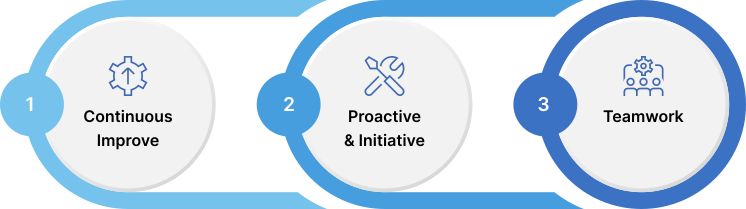
3. Communicate the Sustainability Policy and Strategy to employees at all levels and relevant stakeholders to foster awareness and understanding of sustainability within the organization. This includes strengthening the corporate culture based on the Company’s Core Values: “Achieving the Company’s vision and mission by prioritizing stakeholder satisfaction and maximizing stakeholder benefits through (1) Continuous Improvement, (2) Proactive and Initiative-driven work, and (3) Teamwork.” All employees are encouraged to apply these principles in accordance with their respective roles and responsibilities, while actively contributing to the Company’s journey toward sustainable business development.

Monitoring, Evaluation, and Reporting System
1. The Risk Management, Corporate Governance, and Sustainability Committee is responsible for overseeing and establishing policies and guidelines for the Company’s sustainability management through the Managing Director, who serves as the Chairperson of the Sustainability Committee.
2. The Managing Director is responsible for managing the Company’s sustainability initiatives in alignment with the assigned sustainability policies and objectives through the Sustainability Committee. This includes the development of action plans and the reporting of performance to the Risk Management, Corporate Governance, and Sustainability Committee on at least a quarterly basis.
3. The Sustainability Committee provides guidance and drives the continuous improvement of the Company’s sustainability processes to achieve established objectives through the Sustainability Working Team, which comprises representatives from all internal departments.
4. The Sustainability Working Team is responsible for implementing assigned tasks as directed by the Sustainability Committee and reporting performance outcomes to the Sustainability Committee on at least a quarterly basis.
Review of Sustainability Policy and Strategy
The Company conducts an annual review of its Sustainability Policy and Strategy on a regular basis to ensure they remain current and responsive to changing circumstances, while aligning with the Company’s business policies and objectives. This review also ensures consistency with the United Nations Sustainable Development Goals (SDGs).
