

Sustainability Issue Assessment

The company adopts a sustainable engagement approach that is aligned with the needs and expectations of its stakeholders, while simultaneously creating social and environmental value. Consequently, key sustainability issues are reviewed and continuously developed on an annual basis to ensure alignment with both national and global sustainability standards.
The Company incorporates perspectives from related industries into its considerations through a structured process for identifying and prioritizing material sustainability issues, engaging both stakeholders and external sustainability experts. This process is guided by the Global Reporting Initiative (GRI) Standards, which promote comprehensive, transparent, and comparable sustainability reporting. Such an approach enables the Company to effectively disclose its economic, social, and environmental performance, while supporting the achievement of the United Nations Sustainable Development Goals (SDGs) through a clear reporting framework and practices that respond efficiently to stakeholder expectations.
Process for Identifying Sustainability Issues
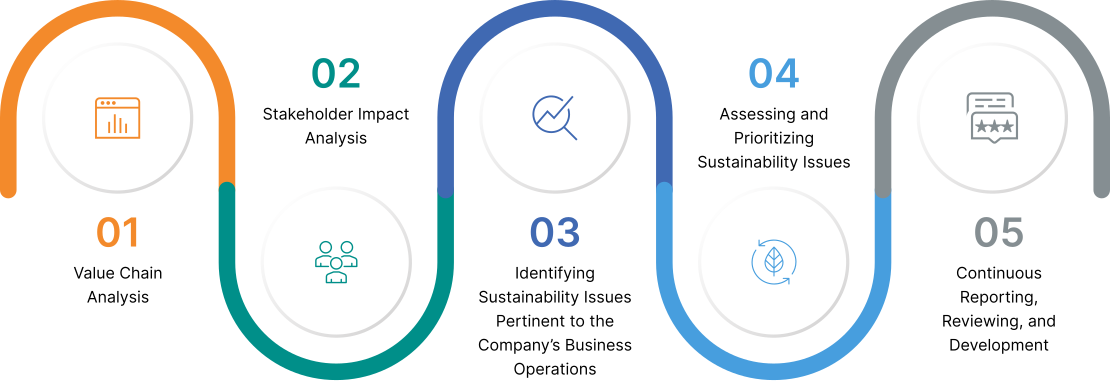
- 1 Value Chain Analysis
The Company conducts a comprehensive analysis of business activities across its entire value chain, encompassing both primary and supporting activities. This analysis is undertaken to obtain relevant information for assessing impacts on all stakeholder groups, ensuring coverage of all activities throughout the Company’s value chain. The stakeholders considered within this value chain include employees, shareholders and investors, customers, business partners, suppliers and contractors, communities and society, as well as environmental authorities.
- 2 Stakeholder Impact Analysis
The Company assesses the impacts of its business operations in relation to each stakeholder group across environmental, social, and governance (ESG) dimensions. These impacts are closely linked to human rights considerations associated with each aspect. To ensure a comprehensive understanding, the Company conducts stakeholder interviews to identify key impact issues as well as related concerns. In addition, relevant issues are compiled from both internal and external sources, including specialized departments and subject-matter experts. This process encompasses both positive and negative impacts, covering short-term and long-term perspectives. The identified impacts represent those that have the potential to affect each stakeholder group.
- 3 Identifying Sustainability Issues Pertinent to the Company’s Business Operation
The identification of sustainability issues relevant to the Company’s business operations serves to establish a structured framework for the consideration of material sustainability topics. This framework encompasses a comprehensive range of factors, including both internal and external influences, the Company’s operational activities and business model, as well as key issues of interest within the water supply industry. Furthermore, the Company takes into account global sustainability trends by referencing leading organizations and internationally recognized sustainability frameworks and standards. These include the Global Reporting Initiative (GRI) Standards, the Stock Exchange of Thailand’s ESG Rating (SET ESG Rating), S&P Global’s ESG Indices, the United Nations Sustainable Development Goals (SDGs), and the United Nations Global Compact (UNGC).
- 4 Assessment and Prioritization of Sustainability Issues
The Company organizes workshops involving executives and employee representatives to analyze and assess the impacts of various sustainability issues on stakeholders, incorporating insights derived from Steps 2 and 3. In addition to evaluating the magnitude of impacts and the likelihood of both positive and negative outcomes, the process also considers linkages to human rights issues. Furthermore, due consideration is given to the severity of impacts across each dimension. This comprehensive approach enables the Company to effectively identify and classify material sustainability topics,as well as fundamental business topics essential to the Company’s operations (Business Fundamental Topics).
- 5 Reporting, Review, and Continuous Improvement
The Company has established plans and operational guidelines to mitigate the negative impacts of both sustainability issues and fundamental business topics. In the initial sustainability assessment process, the findings are submitted to the Company’s executive management and Sustainability Committee for review and approval of disclosure. The Company ensures a continuous review of the process for identifying sustainability issues and consistently discloses relevant information in its Sustainability Development Report. This ongoing approach enables the Company to evaluate impacts and implement appropriate management measures in response to changing environmental, social, and economic conditions each year.
Principle of Double Materiality
The Company acknowledges the importance of managing impacts on stakeholders arising from its business operations. Accordingly, the Company has reviewed its process for identifying sustainability issues in accordance with the principle of Double Materiality, reporting on both dimensions: the impacts generated by the organization (Impact Materiality) and the impacts experienced by the organization (Financial Materiality).
In 2025, the Company conducted an assessment of sustainability issues impacting both stakeholders and the organization’s long-term sustainability, with the active participation of the executive management and the Sustainability Committee. The Company prioritized these sustainability issues in accordance with the GRI Standards and the principle of Double Materiality, identifying a total of 19 material sustainability topics for the organization.
The Company conducted a comprehensive survey of sustainability issues impacting stakeholders (Impact Materiality) across all sectors, and also obtained the perspectives of senior management on issues affecting the organization (Financial Materiality) during the MCM Meeting No. 08/2568. The meeting endorsed the survey findings, which identified 19 sustainability issues encompassing three dimensions: governance/economic, environmental, and social/human rights. The results of the survey on sustainability issues affecting both stakeholders and the organization are summarized in the Double Materiality Matrix.
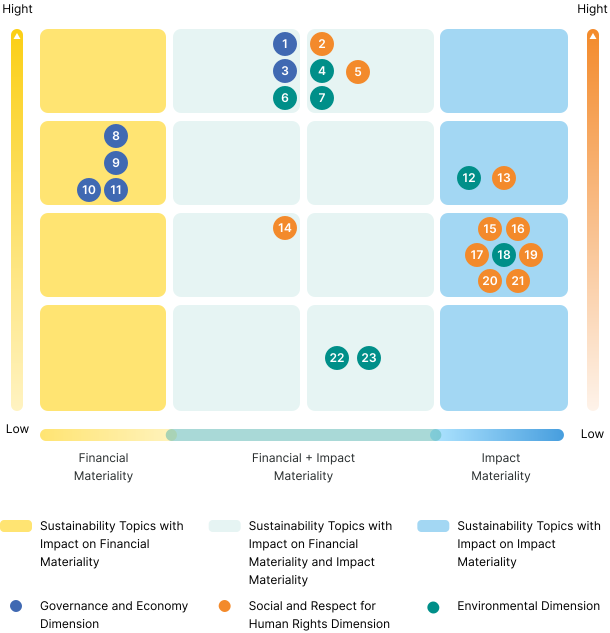
Sustainability Issues
- Biodiversity (E)
- Environmental Supply Chain Management (E)
- Social Supply Chain Management (S)
- Social and Community Stewardship (S)
- Water Management (E)
- Risk Management (G)
- Business Continuity (G)
- Employee Potential Development (S)
- Products and Services Responsibility (G)
- Climate Change Management (E)
- Respect for Human Rights (S)
- Using Resources Efficiently (E)
- Energy Conservation (E)
- Tax Management (G)
- Corporate Governance (G)
- Employment and Employee Stewardship (S)
- Safety and Occupational Health Management (S)
- Anti-Corruption (G)
- Waste and Unused Materials Management (E)
The Company reviews its Materiality Assessment annually to ensure that its impacts, risks, and opportunities are effectively managed in response to changing circumstances. The assessment identifies material sustainability topics based on the Double Materiality principle and presents the results in a Double Materiality Matrix, covering both Impact Materiality (the Company’s impacts on society and the environment) and Financial Materiality (the impacts of sustainability-related matters on the Company). The Double Materiality Matrix uses the horizontal axis to represent Financial Materiality and the vertical axis to represent Impact Materiality, in alignment with international frameworks, including GRI 2021, ESRS, and IFRS S1/S2. Currently, the Materiality Assessment process has not been externally assured; however, the results are reviewed and approved by the Company’s Sustainability Committee.
The Company has also provided relevant functions with training on IFRS S1/S2 to enhance understanding and facilitate management-level discussions on integrating material sustainability topics into the Company’s enterprise risk management framework. These include climate change and other material governance and social issues. For each material risk, the Company identifies risk owners, control measures, and relevant KPIs. The Materiality Assessment therefore serves as an important input to the Company’s Enterprise Risk Management (ERM) process.
Assessment of Sustainability Impacts on External Stakeholders
Based on the nature of its business, the Company identifies sustainability issues that have external impacts in accordance with the Double Materiality principle, considering both the Company’s impacts on society and the environment (Impact Materiality) and the resulting impacts on the Company (Financial Materiality). The material issues include Water Management, Product and Service Responsibility, and Occupational Health and Safety Management. These issues are significant and may affect external stakeholders. The Company uses the assessment results to inform its business strategies, strengthen risk management, and effectively mitigate potential negative impacts on external stakeholders over the long term.
| Sustainability Dimension | Cause of Impact | External Stakeholders | Impact | |
|---|---|---|---|---|
| Positive Impacts | Negative Impacts | |||
| Water Management | Use of raw water and production of tap water | Communities, government authorities, and ecosystems |
|
If inadequately managed:
|
|
Product and Service Responsibility Safety and Occupational Health Management |
Production and distribution of tap water | Customers, society, water users, and communities |
|
If water quality fails to meet required standards:
|
